Elgin Water Hardness, From the Fox River to Your Tap
Elgin water hardness has a long local history. The city switched from deep wells to the Fox River decades ago, and lime softening at the Riverside plant is why the tap water is moderate rather than very hard.
The City of Elgin says its raw Fox River water measures 260 to 400 mg/L of hardness (15 to 24 grains) and is lime-softened to 135 mg/L, about 7.9 grains per gallon. About 75% of the raw supply is river water and 25% deep wells. Its FAQ gives seven to eight grains at the tap.
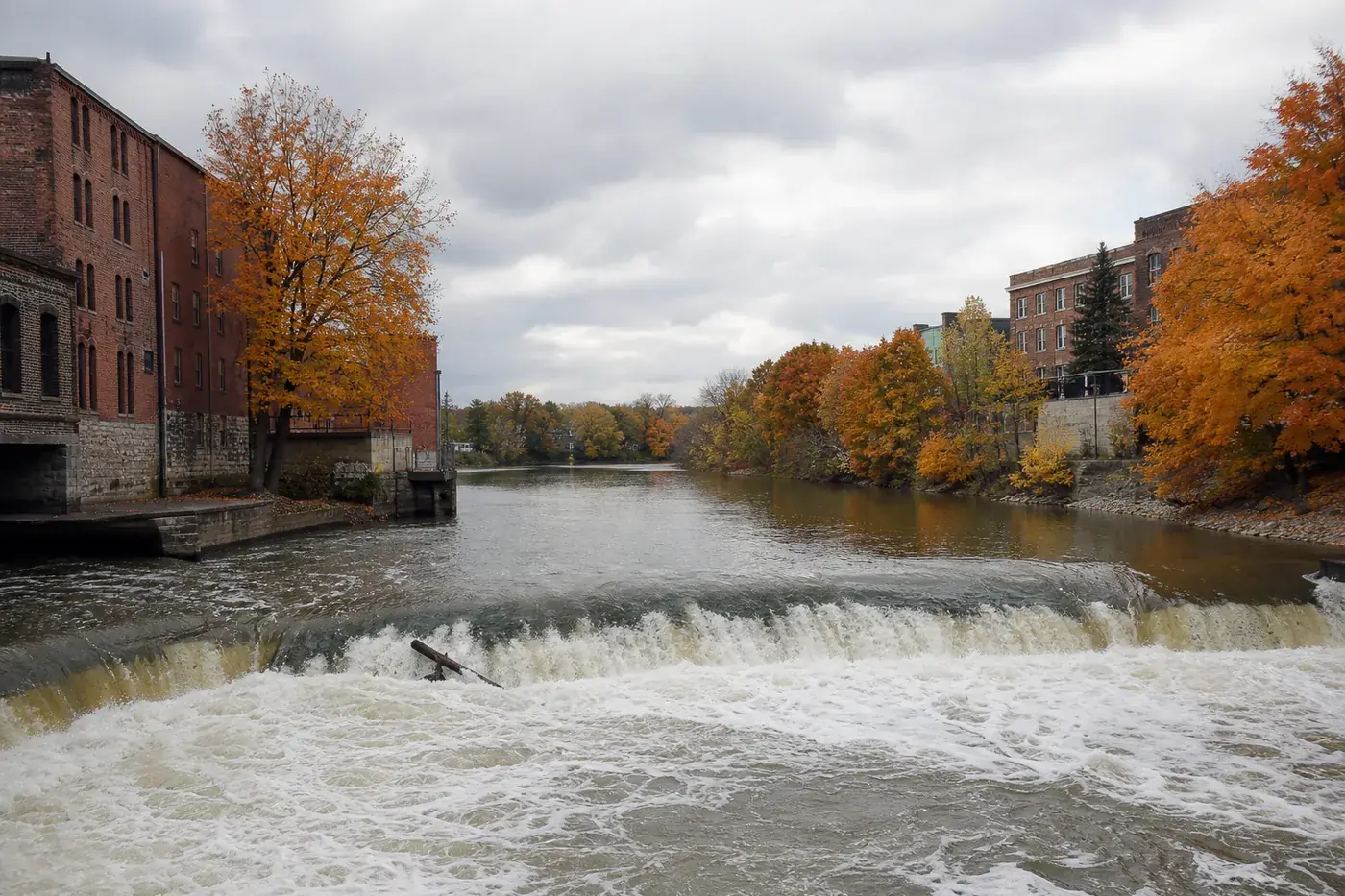
Why did Elgin turn to the Fox River?
Wells came first. The city's history page says a treatment facility at Slade Avenue handled well water, and that by 1940 Elgin produced about 2.29 million gallons a day of it. The Airlite Street plant followed in 1963 for the growing west side. By 1970 the city drew about 7 million gallons a day from the Cambrian-Ordovician aquifer, whose level was dropping as more northern Illinois towns tapped it. Elgin chose the Fox River, completing the Riverside plant in 1982 and doubling its capacity to 32 million gallons a day in an expansion begun in 1997.
What does lime softening at Riverside do?
Lime added during treatment drops calcium and magnesium out of solution so they settle with the sediment. The city lists the full sequence as coagulation and sedimentation, lime softening, chlorination and filtration. The result is a drop from 15 to 24 grains in the raw river to about 7.9 grains leaving the plant. A home softener works differently, exchanging what is left for sodium or potassium; the Elgin softener cost guide shows what that costs.
The other numbers that matter
- Sodium: about 60 mg/L per the city's FAQ; the 2025 report lists 59 ppm. A softener adds more.
- Disinfectant: chloramine at 2.7 to 3 ppm in 2025, under the 4 ppm limit; the plant page gives a combined chlorine residual of 3.0 mg/L.
- Iron: 0.0689 ppm at most in 2025, low enough that iron fouling is a well problem, not a city one.
- Fluoride: about 0.7 mg/L, as required by the Illinois Department of Public Health.
- Radon: the city says radon that may occur in groundwater is removed during lime softening.
Where the two scales put Elgin
The Illinois Department of Public Health calls 100 to 200 mg/L moderate and above 200 hard; at 135 mg/L, Elgin is moderate. The city itself describes its water as softened to between soft and moderately hard. That is why its Water Department considers a home softener unnecessary on city water. If you want one anyway, see setting up a softener in Elgin.
Describe the water at your house
Write a line or two: city water or a well, the age of the house, a softener that misbehaves, or a worry about old pipes. One independent water treatment specialist who works around Elgin will get in touch.